
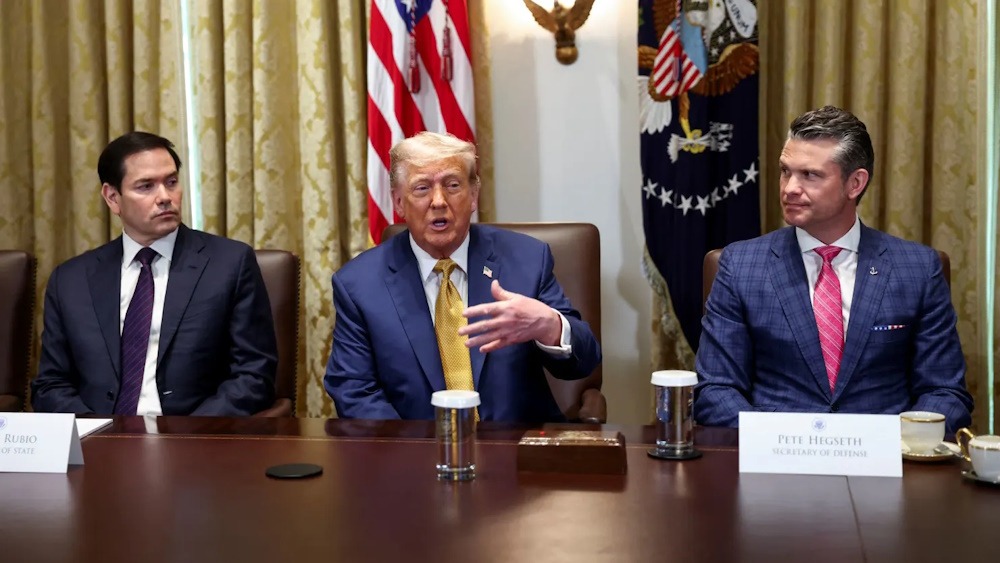
S&P futures declined on Monday following President Donald Trump’s announcement of a blockade of the Strait of Hormuz, as peace negotiations between the U.S. and Iran over the weekend concluded without an agreement. Futures for the Dow Jones Industrial Average declined by 255 points, representing a decrease of 0.5%. S&P 500 futures declined by 0.6%, mirroring the movement of Nasdaq-100 futures. “Effective immediately, the United States Navy, the Finest in the World, will begin the process of BLOCKADING any and all Ships trying to enter, or leave, the Strait of Hormuz,” Trump wrote on Truth Social. “The Blockade will begin shortly. Other Countries will be involved with this Blockade. Iran will not be allowed to profit off this Illegal Act of EXTORTION.”
The collapse of negotiations over the weekend in Islamabad has rekindled concerns that the conflict between the U.S. and Iran may extend beyond initial expectations, resulting in elevated oil prices that are likely to exert further pressure on global economies. West Texas Intermediate crude oil surged 8.1% to $104.38 a barrel. International Brent increased by 7.8% to $102.64. U.S. Central Command announced that it will initiate a blockade of all maritime traffic to and from Iran’s ports starting at 10 a.m. on Monday. The United States has announced that it will not impede vessels navigating the strait en route to ports outside of Iran. Vice President JD Vance departed from Islamabad without securing an agreement with his Iranian counterparts, attributing this outcome to their reluctance to cease efforts towards developing nuclear weapons.
However, both parties seem to be more distanced than merely on that matter, with Iran insisting on control over the Strait of Hormuz, war reparations, and the unfreezing of assets. Officials in Pakistan indicated their intention to attempt to resume discussions in the near future. Trump, having declared the naval blockade following the collapse of negotiations, is contemplating the reinitiation of military strikes, as reported. “The new blockade statement is an overt signal to equity markets that the Iranian conflict remains uncertain, yet traders are viewing this development as a negotiation tactic versus an actual policy implementation, or as a long-term solution for the Strait of Hormuz,” stated Jeff Kilburg. Kilburg indicated that it is plausible for additional buyers to enter the market prior to its opening on Monday.
Expectations for a rapid resolution to the conflict contributed to all three major benchmarks achieving their strongest weekly performance since November, subsequent to the declaration of a two-week ceasefire between the U.S. and Iran. The S&P 500 experienced a rally of 3.6% last week, whereas the Nasdaq saw an increase of approximately 4.7%. The Dow experienced an increase of 3%. This week marks the unofficial commencement of the first-quarter earnings season. The largest banks in the nation are set to commence the earnings season, with Goldman Sachs scheduled to unveil its results on Monday. Citigroup, Wells Fargo, JPMorgan Chase, Morgan Stanley, and Bank of America are scheduled for discussion later this week.