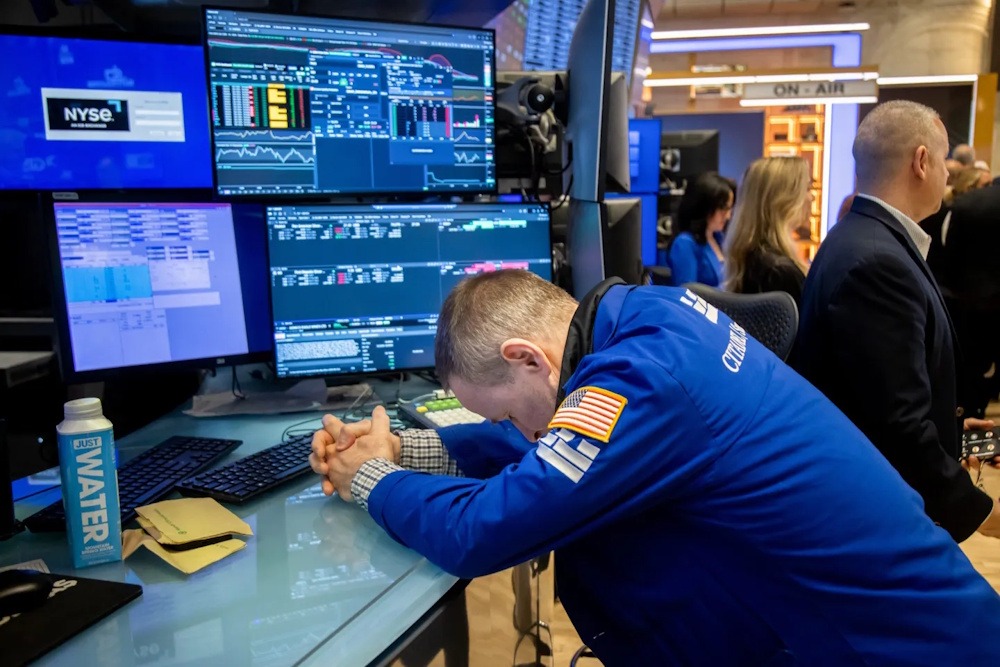
Wall Street concluded the week at an unprecedented peak on Yesterday, as the initial monthly decline in U.S. employment since February led traders to reduce their expectations for Federal Reserve interest rate increases. Equities recorded their most favourable week since mid-April, bolstered by a decline in oil prices, a robust earnings season, and a resurgence in chip stocks. The benchmark index advanced 0.6% to close at 7,753.92 points, a record. The tech-heavy NASDAQ Composite climbed 1.3% to settle at 26,690.62 points, nearing its last record finish recorded at the beginning of June. The blue-chip Dow Jones Industrial Average increased by 0.3%, finishing at 54,036.52 points. For the week, the Nasdaq outperformed with a 5.2% increase, trailed by the S&P at 3.5% and the Dow at 3%. It marked the most favourable week for all three averages since April 17. “The jobs report took down Fed rate hike expectations and cooled bond yields which is an impetus for stocks to get a lift,” Mark Luschini told. “Tech has resumed its leadership which is helping to generate a pretty handsome return for the S&P 500 this week, and along with it pop the stock market to a record high. Relief on the Iranian war front has tempered oil prices which is also a potential boost for consumer spending and may relieve some of the anxiety around the second order effects of high energy costs bleeding into inflation,” he said. “The low hire, low fire environment remains but for now it is sufficient to propel spending, while at the same time not with so much demand thrust that inflation fails to abate over the coming months. If inflation readings over the next couple of months affirm that condition, the corporate profit picture should guide equity markets to new highs,” Luschini added.
According to the U.S. Bureau of Labour Statistics, nonfarm payrolls decreased by 23,000 in July, contrasting with a consensus estimate that anticipated an increase of 85,000. This represented the inaugural monthly decline in employment since February. Meanwhile, employment figures for May and June were adjusted downward by a total of 103,000. The unemployment rate decreased to 4.1% in July, down from 4.2% in June. The reduction in payrolls can be attributed primarily to a decline of nearly 50,000 in local government education positions on a monthly basis. “The miss in July was because of a 53k decline in government employment, which the survey’s detail attributes to local government education jobs (i.e. K-12). This looks like a wonky seasonal adjustment fluke,” Bill Adams said. “The Bureau of Labor Statistics tries to adjust their measurement of K-12 jobs for the big swings that come every year in the summer months, but it’s hard to do in practice. Private employment rose 30,000 in July, which was slow but not a crisis,” he noted. The data arrives during a particularly intricate period for the Federal Reserve. On one hand, despite the negative report, the overall labour market continues to exhibit resilience. Conversely, inflationary risks have escalated significantly amidst the persistent volatility in oil prices stemming from the Middle East conflict. This has led to a discernible inclination among certain policymakers to favour an increase in rates during the Fed’s most recent monetary policy meeting in July.
The divergence in the Fed’s dual mandate presents a dilemma for the central bank. Elevated inflationary dynamics necessitate rate hikes; however, the resilience observed in the labour market indicates limited scope for rate reductions. While elevated borrowing costs can assist in mitigating inflation, they carry the potential risk of adversely affecting the labour market and the broader economy. “Friday’s jobs report was not just much weaker-than-expected, it showed that the economy shed jobs during July, which puts the Federal Reserve in a conundrum, since inflation is still elevated and sticky. While one weak jobs report is not likely to dictate Federal Reserve policy, we think the central bank will maintain its wait and see approach on interest rates, and allow more time to pass to examine incoming economic data,” Brent Wilsey said. “The weaker-than-expected jobs report likely doesn’t change much for the Federal Reserve, as Chair Warsh is allowing the data to guide policy and the data as of now likely warrants keeping rates at current levels,” he said. “Friday’s negative jobs number raises the importance of next Wednesday’s CPI for July, which may see an uptick, since oil prices spiked during the second half of July, given the re-escalation of tensions in Iran. This may very well be one of the more noisy CPI reports in recent memory,” Wilsey added. According to the CME FedWatch tool, the probability of a quarter-point rate increase by the Federal Reserve in September decreased to approximately 42% following the publication of the July jobs report, down from 55% the day before.
Away from the economic calendar, the Philadelphia Semiconductor Index – a key barometer of chip stocks – logged a weekly advance of 9.3%, underscoring a stellar start to August following a more than 20% slide in July. Chip stocks served as the main catalyst for the soaring artificial intelligence trade that propelled Wall Street to a record high earlier in the year, even amidst the ongoing conflict in the Middle East. Over the last two months, the AI trade experienced a decline as investors reassessed a rally that had escalated rapidly and excessively. Concerns were prevalent regarding elevated valuations, ambiguous timelines for returns stemming from substantial investments in AI, and competition from China. However, the impressive quarterly results from Microsoft at the end of July, coupled with the tech giant’s decision to maintain its spending plans amidst the AI boom, signified a turning point in the recent downturn. Robust figures from Amazon have further buoyed sentiment. Traders have recognised the narrative surrounding Leopold Aschenbrenner’s hedge fund, Situational Awareness, as a significant factor influencing both the recent decline in the AI sector and its subsequent recovery. The rebound in the AI trade facilitated Wall Street’s return to a record high on Tuesday, marking the first occurrence since early June. The S&P experienced a decline on Wednesday and Thursday, partly attributed to lacklustre reactions to quarterly results from SpaceX, Advanced Micro Devices, Sandisk, and Western Digital. On Friday, Airbnb and Cloudflare emerged as significant movers in the earnings landscape. Airbnb experienced a notable increase of 17.4% following the release of quarterly results that exceeded expectations, coupled with an upward revision of its annual outlook. Cloudflare experienced a 5.6% increase following the announcement of income and revenue figures that surpassed Wall Street expectations, driven by a growing demand for the infrastructure necessary to scale AI programs.
Turning to the Middle East, Axios reported that Iran was awaiting final approvals from its Supreme National Security Council on a deal with Oman and the U.S. to reopen the critical Strait of Hormuz, citing a diplomat from one of the mediating countries. Reuters subsequently reported that advancements had been made regarding the deal, referencing a U.S. official. On Thursday, Iran’s Fars News reported that the initial text of the plan was undergoing review by authorities, as stated by parliament member Alireza Salimi. According to the framework, the passage of U.S., Israeli, and other hostile vessels thru the vital waterway would be prohibited until compensation was paid, Fars reported. The news agency reported that, according to the plan, entry into the strait would occur via the northern corridor adjacent to the Iranian coast, while exit would take place thru the southern corridor near the Oman coast, as stated by a knowledgeable source within the foreign ministry. Following a designated deadline, transit thru both corridors will cease, with movement instead occurring via a central corridor. Iran will oversee the entry process, while jointly managing the exit in collaboration with Oman. If accurate, these elements of the proposal would likely be deemed unacceptable by Washington. Oil prices on Friday experienced a downturn following a period of volatile trading, positioning them for a weekly decline of approximately 8%.Brent crude futures, the global benchmark, experienced a decline of 0.4%, settling at $82.16 per barrel.