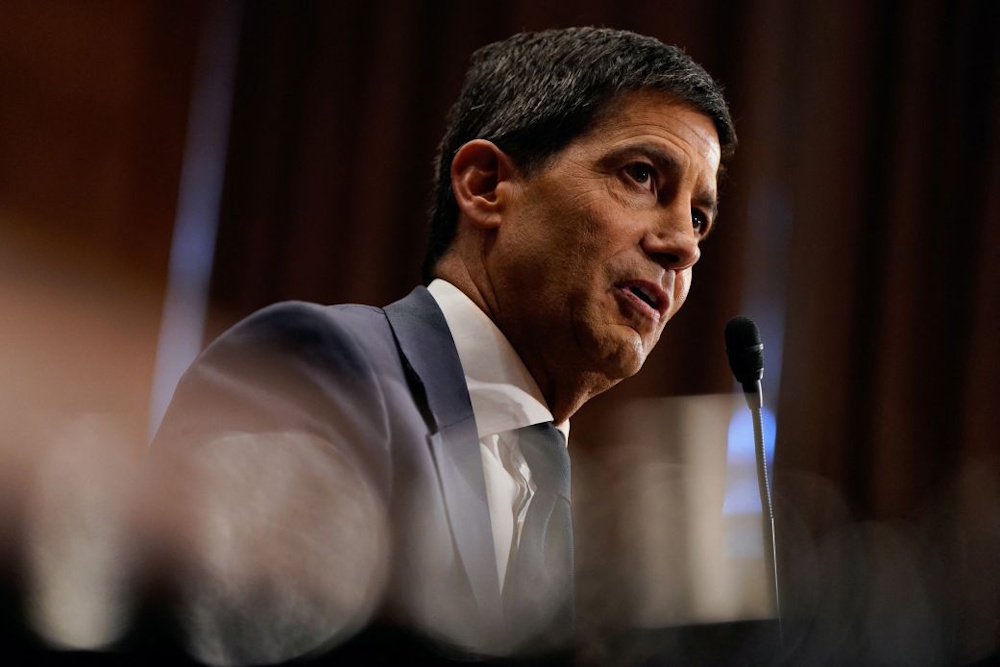
President Donald Trump presided over a ceremony to swear in Kevin Warsh as chair of the Federal Reserve, placing him at the helm of a central bank tasked with steering through a volatile economy while contending with a president who has distinctly articulated expectations regarding interest rates. Trump, whose actions regarding the Fed have raised bipartisan concerns about executive influence on the historically independent central bank, expressed his desire for Warsh to “just do your own thing and do a great job.” And “I want Kevin to be totally independent,” Trump stated at the commencement of the event Friday morning. “Do not direct your gaze towards me, nor towards anyone else.” However, the swearing-in ceremony underscored the president’s unparalleled engagement with the Federal Reserve during his second term: Warsh is the first chair of the Fed to be sworn in at the White House since Alan Greenspan in 1987. Trump articulated his aspirations for the Warsh era more explicitly later on Friday, asserting that interest rates will be decreasing “very quickly.” “You observe what is about to unfold. “I had a rotten head of the Fed, and now I have a great head of the Fed,” Trump said at a campaign-style rally in Suffern, N.Y. “Kevin was just sworn in today, he’s great, he’s going to be great.”
Trump initiated a discussion regarding a housing bill currently under consideration in Congress, but subsequently veered off topic. “To be candid, the housing market fundamentally hinges on interest rates … legislative measures may be abundant, yet the crux remains interest rates.” He told the audience “You get the interest rates down, everybody’s going to be very, very happy.” The Warsh ceremony in the East Room saw the presence of numerous prominent individuals, including Supreme Court Justices Clarence Thomas and Brett Kavanaugh, House Speaker Mike Johnson, along with various other politicians and Cabinet officials. Thomas administered the oath to Warsh. “Our mandate at the Fed is to promote price stability and maximum employment,” Warsh stated following his swearing-in ceremony. “When we pursue those aims with wisdom and clarity, independence and resolve, inflation can be lower, growth stronger, real take home pay higher, and America can be more prosperous, and no less important, America’s place in the world more secure,” he stated. “To fulfil this mission, I will lead a reform-oriented Federal Reserve, learning from past successes and mistakes, both escaping static frameworks and models, and upholding clear standards of integrity and performance,” he stated.
Warsh, 56, is the 11th chair of the Federal Reserve in the contemporary banking landscape, following Jerome Powell, who held the position for eight years. Powell, a significant focus of Trump’s criticism due to his reluctance to reduce rates as rapidly or dramatically as the president wished, will remain at the Fed in his role as a governor. He is the first Fed chair to make such a move in nearly 80 years. Friday’s swearing-in signifies Warsh’s second tenure at the Federal Reserve. He previously served as governor from 2006 to 2011, a period during which the central bank collaborated with Treasury officials to stabilise the economy in the wake of the global financial crisis. Although Warsh contributed to the Federal Reserve’s initiatives, he subsequently expressed criticism towards the central bank for permitting the continuation of crisis-era policies and for exceeding its mandate concerning stable prices and low unemployment. He has pointed to previous initiatives aimed at tackling climate change and social inequality as examples of mission creep, and has committed to reducing the central bank’s influence on markets.
Warsh secured the position after a comprehensive contest that commenced in the summer of 2025, featuring up to 11 contenders, which included both current and former Federal Reserve officials, as well as notable economists and Wall Street strategists. Powell’s tenure was characterised by frequent and at times personal critiques from Trump. The president called for more assertive measures from the Fed regarding interest rate reductions and criticised Powell for exhibiting what he termed “Trump derangement syndrome,” despite the fact that the Fed had already decreased its benchmark borrowing rate by three-quarters of a percentage point and increased it by 4.25 points during a particular period of the Joe Biden administration. Despite Trump’s demands for lower rates, markets are anticipating that the Fed will maintain its current stance through the majority, if not the entirety, of 2026, with potential rate hikes projected for early 2027. The Powell run was also marked by inflation consistently exceeding the Fed’s 2% target for five consecutive years. Warsh has asserted his ability to manage inflation while simultaneously reducing benchmark rates. Since departing from the Federal Reserve, Warsh has engaged in activities at Stanley Druckenmiller’s Duquesne Family Office, while also serving as a lecturer at Stanford University and the Hoover Institution. Warsh was considered a prominent contender for the position of Fed chair when Trump indicated he would not be renominating Janet Yellen. However, the president ultimately selected Powell, reportedly influenced by former Treasury Secretary Steve Mnuchin.