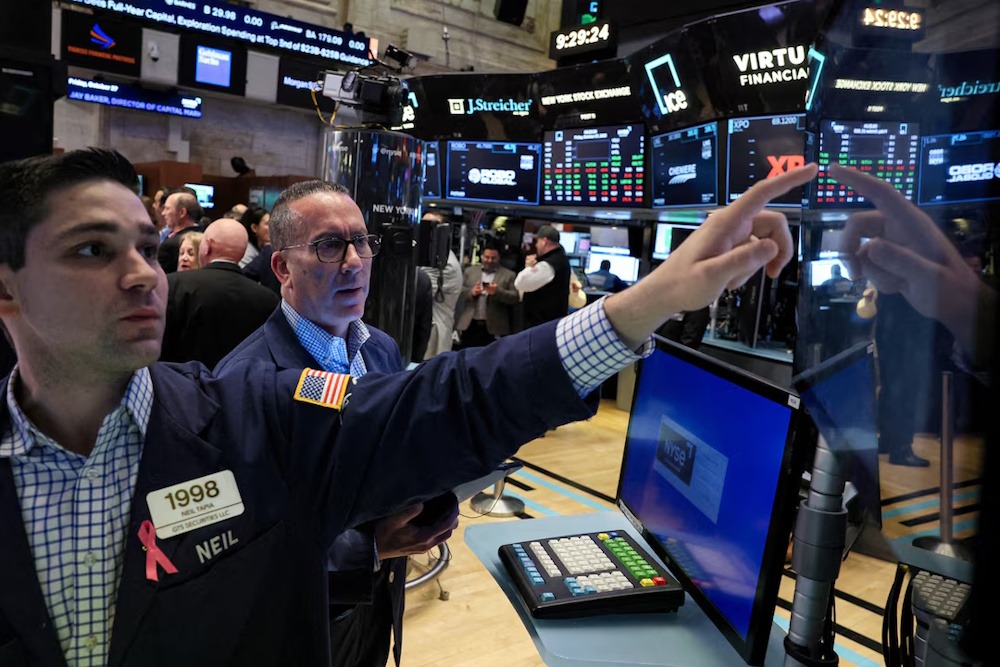
Nasdaq and S&P 500 futures showed an upward trend early Monday as chip stocks recovered from the previous day’s decline. Meanwhile, President Donald Trump sought to uphold a delicate ceasefire amidst ongoing strikes between Iran and Israel. S&P 500 futures and Nasdaq 100 futures showed an increase of 0.6% and 1.1%, respectively. Futures associated with the Dow increased by 85 points, reflecting a gain of 0.2%. Shares of Micron Technology, the memory chipmaker that has been a driving force in the recent bull market, experienced an increase of over 5% in premarket trading following a decline of 13% on Friday. Shares of Nvidia and Broadcom experienced an upward movement. The Nasdaq Composite experienced a decline of 4.2% on Friday, marking its most significant drop since April 2025. This downturn occurred as investors opted to take profits on chip stocks, driven by concerns that the shares had risen excessively in light of the uncertain economic environment. The iShares Semiconductor ETF experienced an increase of nearly 4% in early trading on Monday, following a significant decline of 10% on Friday, marking its most substantial drop in over six years.
Strikes by Iran on Sunday have heightened concerns regarding the stability of the ceasefire between Washington and Tehran. The reported missile attack came after a post on X by Iranian Parliament Speaker MB Ghalibaf, who contended that the U.S. naval blockade and purported violations of agreements concerning Lebanon represent breaches of the ceasefire. WTI crude oil experienced an increase of over 1%, reaching approximately $92 per barrel. This rise follows reports from the IDF X account regarding Israel’s execution of a “large-scale strike on strategic defence systems” on Monday, in retaliation for attacks from Iran. Trump stated that Israel and Iran “are looking to do an immediate ceasefire” and indicated that negotiations were ongoing despite the attacks. Trump previously mandated that Iran and Israel “must immediately stop” their attacks. Oil retreated from its peak levels of the session following comments made by Trump.
Asia-Pacific markets experienced significant declines on Monday following the drop in the Nasdaq on Friday. South Korea’s benchmark Kospi was particularly affected, plummeting over 8% to close at 7,484.41. Japan’s Nikkei 225 experienced a decline of 3.85%, closing at 64,024.6. “The stock market may be becoming a victim of its own success,” stated Callie Cox. “The job market has improved, but the concern of consistently high inflation appears to be a significant risk on many people’s minds.” And “Growth and momentum have outpaced almost everything since the March lows,” she noted. “This outcome is not typical for a high-rate, high-inflation setting, and these strategies could face challenges if cost pressures remain high.”
In the upcoming week, market participants will be closely monitoring inflation metrics and the highly anticipated public launch of Elon Musk’s SpaceX on Friday. The offering is anticipated to rank among the largest in Wall Street history and may serve as the market’s most significant evaluation of the AI valuation narrative to date. “Blockbuster offerings have marked the peak of excess in past market cycles, so there seems to be an awkward silence around what this could signal for sentiment,” Cox stated. “A considerable number of investors appear to be cautious and doubtful, yet can such a mindset persist when the largest IPO in history is approaching?”