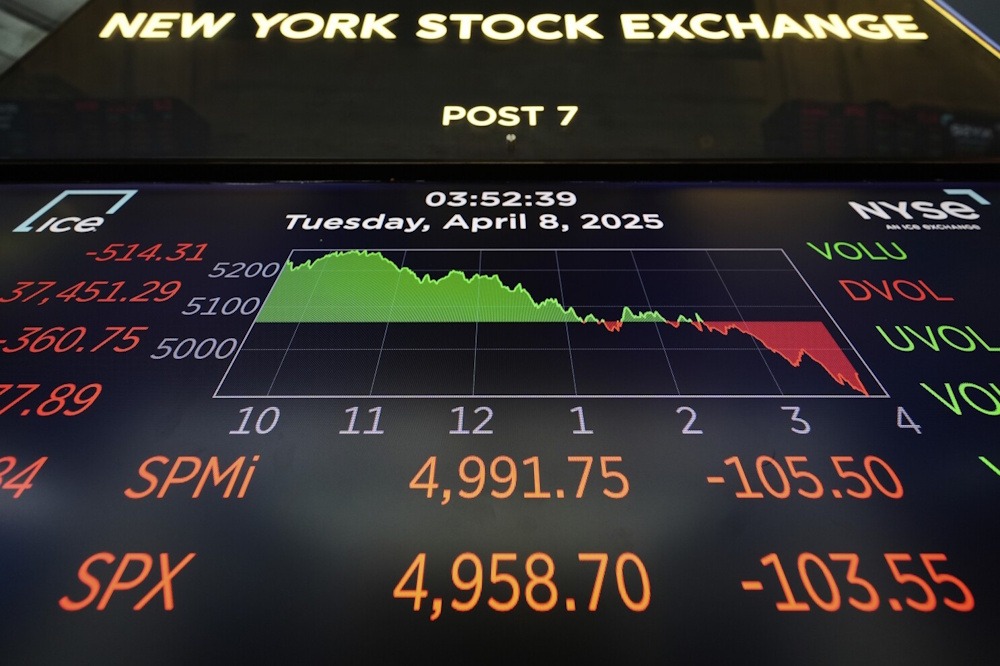
S&P futures declined on Tuesday as market participants anticipated the Federal Reserve’s forthcoming policy decision later this week, a move that could have significant implications for the economy, while Treasury yields rose to levels not seen in several years. S&P 500 futures declined by 0.3%, mirroring the movement of Nasdaq-100 futures. Futures associated with the Dow Jones Industrial Average declined by 229 points, representing a decrease of 0.4%. On Tuesday morning, the yield on the benchmark 10-year Treasury note increased to its highest level since 2007, hitting 5.041%. Bond yields and prices exhibit an inverse relationship. In recent weeks, equity markets have been closely monitoring global government bond yields, as government debt has experienced a sell-off. This trend is largely driven by escalating concerns that the ongoing U.S.-Iran conflict may exacerbate inflationary pressures, prompting a more hawkish stance from central banks. Oil prices experienced a slight increase following Saudi Arabia’s closure of a significant pipeline that circumvents the Strait of Hormuz.
As a result, Brent futures concluded above $105 per barrel, while West Texas Intermediate crude settled at over $101. Crude oil prices continued their upward trajectory on Tuesday, as Brent crude oil futures for November delivery increased by 1.8%, reaching $107.55 per barrel. Meanwhile, WTI futures experienced a rise of nearly 2%, trading at $103.36. As Treasury yields and oil prices persist in their upward trajectory, the impending decision regarding the Fed’s policy rate, anticipated on Wednesday, is increasingly occupying traders’ attention. Fed funds futures trading indicates a probability of approximately 92% that the central bank will increase rates by a quarter point from the existing target rate range of 3.5% to 3.75%. That decision could have far-reaching implications for the global economy. “We expect the Fed to, for the first time in the [Chairman Kevin] Warsh era, raise its policy rate to an upper bound of 4.0% at this week’s meeting,” said Christopher Hodge.
“We also think that he will emphasize that this decision was discrete and does not pre-commit the Fed to any actions in subsequent meetings, giving him and the Committee maximum flexibility to respond to shocks,” he added. A sell-off in artificial intelligence-related names has exerted downward pressure on the stock market following remarks from Anthropic CEO Dario Amodei advocating for a more measured approach to AI development. Over the weekend, OpenAI CEO Sam Altman also ruled out an initial public offering this year, citing increasing concerns regarding AI safety. A slate of AI-connected stocks experienced a decline, with Nvidia falling by 3% and speciality glass and fibre optic company Corning plummeting by 13%. The iShares AI Innovation and Tech Active ETF experienced a decline of nearly 4%. In a note on Tuesday morning, Barclays strategists indicated that elevated rates had already exerted pressure on valuations and were progressively placing equity portfolios in jeopardy.
“While earnings have so far offset the drag, the approaching 5% threshold in 10Y yields marks a historically important inflection point, beyond which rates have typically become a more persistent headwind for equities,” they said. “With inflation risks lingering and yields moving higher, the cushion provided by earnings growth may become increasingly difficult to maintain.” And “Our base case remains constructive on equities, supported by continued earnings momentum, but the risk of a sharper repricing grows if yields move materially above current levels,” they added. Asia-Pacific markets concluded the trading session on Tuesday with declines. Japan’s Nikkei 225 exhibited minimal fluctuation, settling at 63,484.1. South Korea’s Kospi experienced a decline of 0.85%, concluding the trading session at 6,627.26. Hong Kong’s Hang Seng Index declined by 1% to 24,667.24, whereas mainland China’s CSI 300 experienced a decrease of 0.67% to 4,450.04.