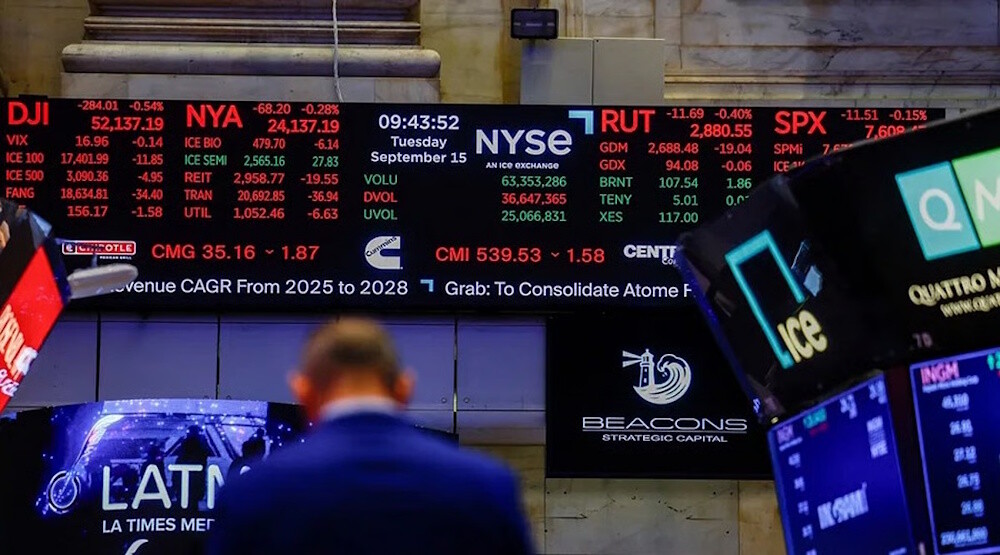
S&P futures were lower early Wednesday, following a decline in tech stocks during the regular session that pushed the S&P 500 and Nasdaq Composite down. Futures for the Dow Jones Industrial Average were observed down 391 points, representing a decline of 0.8%, whereas S&P 500 futures experienced a drop of 1.4%. Nasdaq-100 futures experienced a decline of 2.3%. Wall Street has experienced a downturn, with the S&P 500 and Nasdaq Composite both closing lower. This decline was driven by a retreat in technology stocks, notably as Nvidia experienced a significant drop and Anthropic traded below its initial public offering price. The broader index experienced a decline of 0.5%, while the Nasdaq saw a more pronounced decrease of 1.5%. Conversely, the 30-stock Dow, characterised by its reduced exposure to technology, experienced an increase of over 400 points, translating to a rise of 0.9%.
Nvidia and Anthropic experienced declines in pre-market trading on Wednesday, with the stocks decreasing by 5.3% and 6%, respectively. Tuesday’s erratic trading activity was merely the most recent episode in a month characterised by volatility. Prior to the ousting and subsequent reinstatement of Nvidia’s Jensen Huang, as well as the Democrats’ success in the midterm elections, investors were already contemplating the trajectory of the artificial intelligence expansion in light of a deteriorating macroeconomic environment. “Let’s remember that the sell-off in the AI ecosystem predated the news about Huang and Nvidia,” Liz Ann Sonders told. “The concerns about capex, the data center build-out, the spread between the cost of capital and return on invested capital, the bifurcation that’s happening in the market now between sort of profitable segments of the market and unprofitable,” she added. “I think that is the bigger, more aggregate story.”
Traders are anticipating new inflation data and are closely observing reports indicating that the White House is set to announce a series of new tariffs affecting more than a dozen significant trading partners, including China and the European Union. The personal consumption expenditures price index for October is scheduled for release on Wednesday morning. Economists surveyed by Dow Jones anticipate that the headline reading will increase by 0.3% for the month and 3.8% on an annual basis. Weekly jobless claims are set to be released a day earlier than the typical schedule, coinciding with the closure of U.S. markets on Thursday in observance of the Thanksgiving holiday. In Asia, South Korea’s Kospi experienced a decline of more than 6% on Wednesday, whereas Japan’s Nikkei 225 decreased by 2.88%. Hong Kong’s Hang Seng Index experienced a decline of 0.13%, whereas mainland China’s CSI 300 saw a more significant drop of 1.49%.
Australia’s S&P/ASX 200 experienced a decline of 0.39%. European shares exhibited a general upward trend on Wednesday, as the pan-European Stoxx 600 index increased by approximately 0.3%. However, regional tech stocks declined as the global sell-off of semiconductor and AI-related assets persisted. In a note on Wednesday morning, Deutsche Bank’s Jim Reid said a “risk-off tone” had returned to the market over the last 24 hours, adding: “It’s pretty wild out there.” And “If you’re looking for good news, we’re back to the rotation trade rather than the indiscriminate sell-off we saw towards the end of last week,” he said, pointing to rallies in defensive sectors like healthcare and consumer staples.