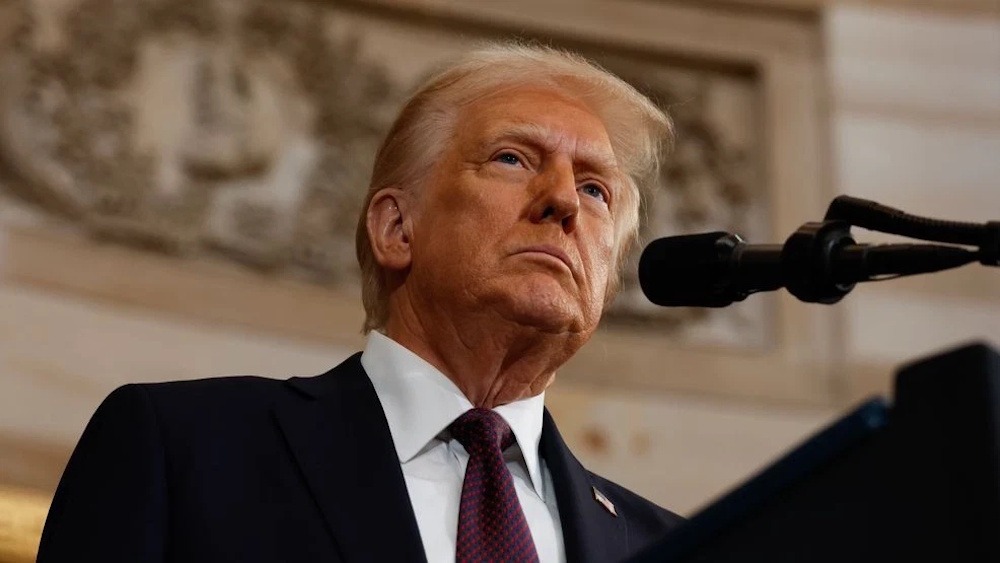
President Donald Trump concluded a meeting in the White House Situation Room without disclosing his ultimate decision regarding the approval of a deal to suspend the three-month-old Iran conflict, as reported. Trump earlier Friday stated on Truth Social that he would be making his “final determination” during that meeting, after outlining the conditions that Iran must fulfil for him to approve a deal. It remains uncertain from Trump’s statement which of his critical stipulations are already included in the preliminary agreement that U.S. and Iranian negotiators are currently discussing to halt the conflict. Iran “must agree” to never have a nuclear weapon, and the Strait of Hormuz must be “immediately open” to unrestricted shipping traffic, with no tolls being imposed, Trump demanded in the Friday morning post. He also stated that the retaliatory U.S. naval blockade against Iran in the Gulf of Oman “will now be lifted,” although it remained ambiguous whether he implied that this action would be contingent upon the fulfilment of prior conditions. Trump also stated that enriched material buried at the site of last year’s attacks on Iran’s nuclear facilities will be “unearthed” by the U.S. “in close coordination and conjunction with the Islamic Republic of Iran, plus the International Atomic Energy Agency, and DESTROYED.” Trump added “No money will be exchanged, until further notice.” And “Other items, of considerably lesser significance, have been concurred upon.” He stated “I will be meeting now, in the Situation Room, to make a final determination.” Oil prices declined in response to Trump’s post.
The precise details of the agreement under consideration remain ambiguous. Iranian state news outlet Fars, following Trump’s post on Friday, countered the president’s assertion, stating it “raised issues that contradict the provisions of the agreement’s text.” Despite Trump’s reference to a toll-free strait, there is “no such clause in the text of the agreement,” Fars reported in a translated Telegram post, citing “informed sources.” The draft deal under consideration reportedly lacks any mention of Iran dismantling or destroying its nuclear materials, as noted by the Fars post. Fars emphasised that “the most important part of the agreement” is “the immediate payment of $12 billion of Iran’s frozen assets.” Iran will decline any additional negotiations unless that payment is received, according to Fars. A White House official on Thursday confirmed a report indicating that the U.S. and Iranian negotiating teams have established a 60-day memorandum of understanding. This agreement aims to prolong the current ceasefire and facilitate discussions regarding nuclear matters. The memorandum would additionally eliminate restrictions in the strait and stipulate that Iran is required to clear all mines from the waterway within a 30-day period, while the U.S. would correspondingly lift its blockade. Addressing Iran’s highly enriched uranium and enrichment goals will be paramount during the 60-day window, as indicated by the report. The draft would also set the stage for negotiations regarding sanctions relief and the release of frozen Iranian funds.
Trump’s recent indication of advancement toward a U.S.-Iran peace agreement stands in stark contrast to the ongoing economic and military confrontations between the two nations, alongside persistent anti-U.S. rhetoric from Iranian officials and state media. The Pentagon announced Thursday morning that Iran had initiated a ballistic missile launch aimed at Kuwait and had positioned attack drones in and around the strait. Iranian media reported late Thursday local time that the country’s armed forces launched missiles at unidentified targets. The U.S. Treasury on Wednesday and Thursday unveiled new sanctions against Iran, which include measures aimed at countering Tehran’s recent initiatives to assert control over transit through the strait. Iranian officials, in X posts published prior to Trump’s statement Friday morning, exhibited a defiant stance toward the U.S., emphasising their relationships with neighbouring countries in the Middle East, including Oman, which has recently been a focus of Trump’s threats. Oman has reportedly engaged in discussions with Iran regarding the imposition of charges on vessels navigating the Hormuz Strait, a crucial artery for global oil transportation that has faced significant disruptions due to Iranian threats since the onset of the conflict.
During a Cabinet meeting on Wednesday, Trump stated that “Oman will behave just like everybody else, or we’ll have to blow ’em up.” On Thursday, Treasury Secretary Scott Bessent cautioned Oman that the U.S. will “aggressively target” anyone involved in “facilitating tolls” for the strait. A social media account linked to Iran’s parliamentary speaker Mohammad Bagher Ghalibaf provided a cryptic yet assertive summary of the ongoing negotiations in a translated post on Friday morning. “We seize concessions not through dialogue, but with missiles; in negotiations, we merely make them understand,” Ghalibaf’s account stated. “We have no trust in guarantees or words—only actions are the measure. No action will be taken before the other side acts,” the post stated. “The winner of any agreement is the one who is better prepared for war from the day after.” Iranian Foreign Minister Abbas Araghchi communicated with his Omani counterpart, stating that he conveyed Iran’s solidarity with Oman in the face of any threat.