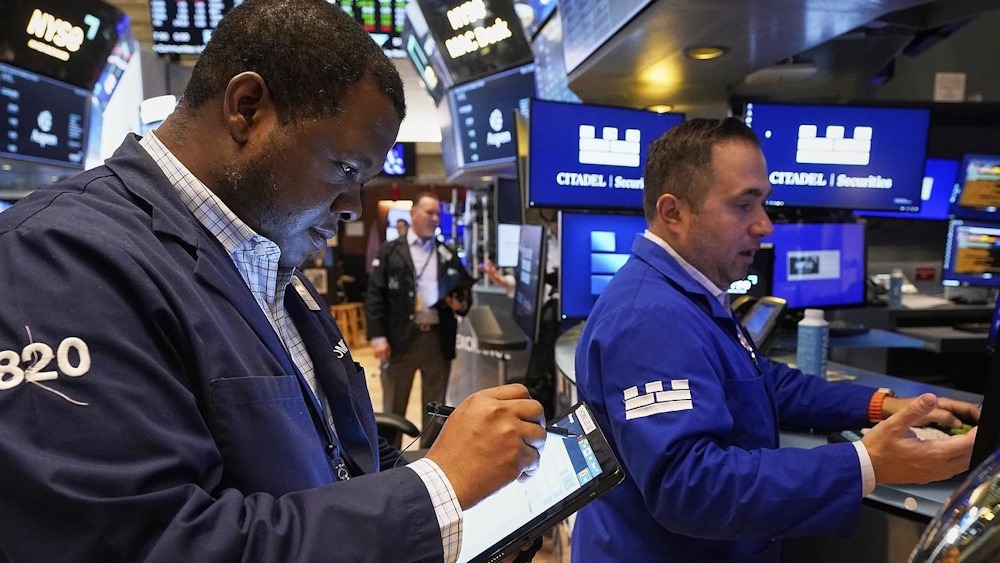
S&P futures declined early Monday, with semiconductor stocks mirroring the significant downturn of their global counterparts in premarket trading. Traders are assessing the recent developments in the Middle East while preparing for an upcoming wave of corporate earnings announcements scheduled for later in the week. S&P 500 futures declined by 0.3%, whereas Nasdaq-100 futures experienced a decrease of 0.9%.Futures for the Dow Jones Industrial Average remained near the neutral point. Semiconductor companies faced downward pressure prior to the market’s opening. U.S.-listed shares of SK Hynix experienced a decline of 8% after the South Korean chipmaker’s debut on Nasdaq, during which it had surged by 13%. Shares in Micron Technology experienced a decline of 5.2%, whereas Sandisk saw a pullback of 6.3%.Seagate Technology experienced a decline of 4%. Elsewhere, Advanced Micro Devices experienced a decline of 2.6%, mirroring the performance of Intel. Over the weekend, Iran and the United States engaged in reciprocal airstrikes, with Tehran directing its efforts towards U.S. installations across various Gulf nations and announcing the closure of the Strait of Hormuz.
However, President Donald Trump contested the assertion on Sunday, stating that the crucial waterway remained accessible for commercial navigation. On Saturday, Trump authorised airstrikes against Iran in response to an attack by Iran on a commercial vessel navigating the strait. Crude prices experienced an uptick in early trading amid rising tensions. Brent futures increased by 2.9%, reaching $78.19 per barrel. West Texas Intermediate futures increased by almost 3% to reach $73.49. “The Strait closure will hang over the market with a risk-off tone,” wrote Ben Emons. “Still, unless there is a serious prospect of a closure in the coming months, which could cause major global energy shortages … the focus next week will (also) be on CPI, Warsh, and bank earnings.”
Major U.S. banks — including JPMorgan Chase, Goldman Sachs, Morgan Stanley, Bank of America, Citigroup, and Wells Fargo — are part of the 28 S&P 500 companies scheduled to announce their earnings this week. Quarterly results from Netflix, Johnson & Johnson, and UnitedHealth are forthcoming. Anticipations for the season are elevated. On average, analysts project that second-quarter S&P 500 profits increased by over 23% compared to the previous year, according to source. One sector to monitor, as noted by Raymond James CIO Larry Adam, is technology. Specifically, the question arises as to whether AI can continue to enhance earnings within the sector. “Despite concerns that hyperscalers may start to moderate AI-related capital spending, we expect capex plans to be reaffirmed and to rise through 2028. Why? Because there is tangible evidence that businesses benefit from AI adoption. Mentions of AI across all 11 sectors are up 98% YoY, reaching new highs,” Adam wrote to clients.
The June CPI report is scheduled for release on Tuesday morning. European markets were in negative territory on Monday morning, as tensions in the Middle East weighed heavily on the continent’s sectors, leading to a predominantly negative performance. The pan-European Stoxx 600 experienced a decline of 0.1%, with the majority of regional sectors and major exchanges also trending downward. Oil and gas companies drove the upward movement, whereas European semiconductor stocks mirrored the decline observed among their Asian counterparts. In Asia, markets predominantly concluded on a downward trajectory. South Korea’s Kospi experienced a decline of nearly 9%, primarily influenced by the downturn of SK Hynix, while Japan’s Nikkei 225 registered a decrease of 1.92%. China’s CSI 300 experienced a decline of 1.79%.