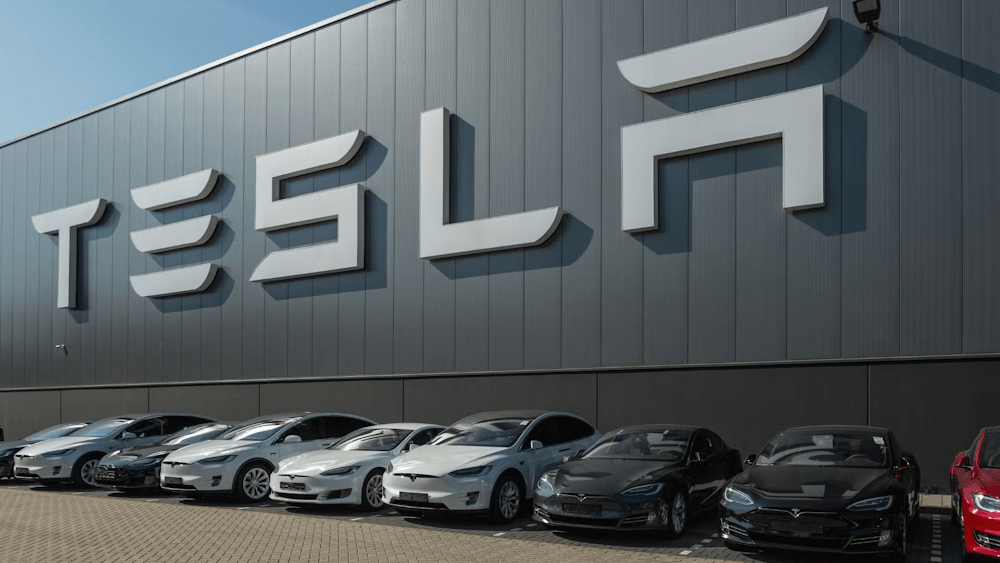
Tesla reported vehicle deliveries and production levels for the second quarter that significantly surpassed Wall Street expectations, as Elon Musk’s automaker seeks to recover from consecutive annual declines in auto sales.
Here are the essential figures:
- Total Q2 vehicle deliveries amounted to 480,126.
- Total Q2 vehicle production: 451,758
Analysts had anticipated approximately 406,600 deliveries, as per the consensus from StreetAccount. Tesla’s company-compiled consensus published last week indicated 406,024 deliveries. Shares of Musk’s EV maker declined approximately 7.49% on Thursday, notwithstanding the robust report. The stock experienced its most significant decline in nearly a year, continuing a downward trend following each of the last three quarterly delivery reports. In the corresponding period of the previous year, Tesla recorded approximately 384,000 deliveries, while in the first quarter of 2026, the figure stood at 358,023. Thursday’s update indicated a 25% year-over-year increase and a 34% increase compared to the first quarter in deliveries for Tesla. Tesla does not disclose precise delivery figures by region or specific model; however, the company reported that its entry-level Model 3 sedan and the widely favoured Model Y SUVs constituted 467,762 units, representing 97% of total deliveries. Deliveries represent the nearest estimation of sales as communicated by Tesla, yet they lack a precise definition in the company’s shareholder communications.
Tesla is attempting to rebound from successive yearly decreases in vehicle sales, which were partially attributed to a consumer backlash against Musk, the world’s wealthiest individual, as well as the elimination of a U.S. federal tax credit. Musk’s incendiary political rhetoric, endorsements of anti-immigrant extremists in Europe, and his collaboration with the Trump administration to reduce the federal workforce have deterred certain potential EV buyers. Meanwhile, Chinese automakers such as BYD, Nio, and Xiaomi entered the market with a range of more affordable and technologically advanced electric vehicles, while Tesla encountered heightened competition from South Korea’s Hyundai Motor Group and European electric vehicle manufacturers, including Volkswagen. To revitalise sales, Tesla initiated the sale of lower-cost variants of its Model 3 and Model Y vehicles. More recently, it has made its driver assistance systems, branded as Full Self-Driving (Supervised), accessible in select European markets. The most significant advantage for the company during the quarter appears to be the surging petrol prices attributed to the conflict in Iran. European car buyers acquired a greater number of Tesla and other electric vehicles during the first half of the year. However, oil prices are now back near their pre-war trading levels from February, influenced by a tenuous truce between the U.S. and Iran, alongside diplomatic initiatives aimed at achieving a sustainable resolution to the conflict.
In the United States, there has been a noticeable shift among car buyers, who are increasingly favouring hybrids over fully electric vehicles, as noted by Dan Hearsch. “We have a huge country, and people live far away from each other compared to Europe where the charging infrastructure is better and people don’t have to drive quite so far,” Hearsch stated. In the latter half of the year, inflation, alterations in trade policy, and the escalating costs of chips and other components are likely to present significant challenges for U.S. automakers, he noted. Musk has instructed Tesla to concentrate on increasing the production and sales of its Semi electric trucks, as well as to initiate the production of its autonomous Cybercab. The company is also seeking to initiate production of its Optimus humanoid robots. In Tesla’s first quarter investor update, the company stated it was “optimizing” its vehicle portfolio, “with an emphasis on vehicles designed for a fully autonomous future” and expected “volume production of both Cybercab and the Tesla Semi this year.” Tesla announced in January its decision to cease production of its flagship Model S and X vehicles, reallocating the factory lines in Fremont, California to the manufacturing of Optimus units.
In its Energy business, which focuses on the installation of solar photovoltaics and the sale of battery energy storage systems, Tesla reported a deployment of 13.5 GWh in the second quarter of 2026, an increase from 9.6 GWh in the same period the previous year. Analysts had projected a figure of 13.3 GWh. Musk’s SpaceX, which owns xAI, acquired $269 million in Tesla Megapacks in April, as detailed in its IPO filing. SpaceX is utilising the Megapacks to lower xAI’s electricity expenses at its energy-intensive data centers located in and around Memphis, Tennessee. In the second quarter deliveries report, Tesla refrained from indicating whether related-party transactions played a role in the robust figures. Last year, SpaceX allocated $131 million towards the acquisition of Tesla Cybertrucks. The dollar amount in question constituted a significant share of the 20,237 Cybertrucks sold by Tesla in 2025, as reported by Kelley Blue Book. Tesla is set to disclose its financial results for the second quarter on Wednesday, July 22, following the market’s closure.